


New to quilting? Click here for a beginner in-depth sewing class covering all the basics.
How to Sew a Churn Dash Quilt Block
The Churn Dash is a beloved traditional quilt block that has been popular for generations. It’s a great block for showcasing two contrasting fabrics.
Materials:
- Fabric in at least two contrasting colors
- Rotary cutter or scissors, cutting mat & ruler
- Sewing machine or needle and thread
- Iron and ironing board
Cut your fabric:
- One 4½" center square (Color A)
- Four 2½" squares in Color A
- Four 2½" squares in Color B
- Two 2½" × 6½" rectangles in Color B
Instructions:
- Pair one 2½" Color A square with one 2½" Color B square, right sides together. Sew along one edge. Repeat to make 4 two-square units.
- Sew a 2½" × 6½" Color B rectangle to the top and bottom of two of the two-square units to create the churn dash side units.
- Sew one churn dash unit to each side of the center square, pressing seams toward the churn dash pieces as you go.
- Continue adding units to all four sides of the center square until the block is complete.
- Press all seams with an iron toward the churn dash pieces.
- Repeat to make as many Churn Dash blocks as needed for your quilt.
Mix and match colors across blocks for a scrappy, eclectic look — or keep a consistent palette for a classic finish. Happy quilting!
Making Half-Square Triangles
This technique eliminates the need to directly manipulate the stretchy bias of the triangle. It uses two easy-to-cut squares to produce two half-square triangles.
On the back of the lighter fabric, draw a pencil line diagonally from corner to corner.

Stack a pair of light and dark squares right sides together. Sew a ¼" seam allowance on each side of the line.

You will end up with something like this:

Now cut along the diagonal line.

Press the seam to set it, then press toward the darkest fabric.
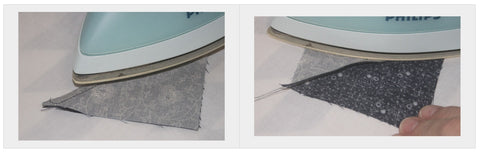
To trim to the exact size, line up the 45° diagonal on your ruler with the seam.

Then carefully trim your block with a rotary cutter.

Nine Patch Piecing
The secret to the nine patch is pressing seams so they butt when joined. Cut 5 A squares and 4 B squares in the required size.
Using chain piecing, join a B square to 3 of the A squares, right sides together, with a ¼" seam allowance. The result will be:

Next, chain piece the remaining A and B squares to these units:

Your result will be:

To make this faster, cut A and B strips at the appropriate width and join into A/B/A and B/A/B units. Press every seam toward the dark fabric, then cut across the pre-joined strips:

Same result, but faster:

This methodology applies to all kinds of 9-patch blocks — as long as the block has an underlying 3×3 grid, the principle applies.

When it’s not obvious which direction is the dark in complicated blocks, remember the basic ironing plan:

How to Resize Quilt Blocks
The first step in modifying any quilt block is to decide on the finished size. You can base this on doubling a pattern, cutting it in half, or working with your available fabric.
Important: Always remove the seam allowance before doubling or tripling the size. For example, if your pattern calls for 3½" squares, subtract the seam allowances (½"), double the finished block size (3" → 6"), then add the seam allowance back (½"). You’ll end up cutting a 6½" piece of fabric.
Resizing Square Blocks
Add ½" to your desired finished block measurement. For a 4" finished square, cut a 4½" square of fabric.
Resizing Rectangular Blocks
Add ½" to both the length and width. To double a block that measures 3" × 4", cut a 6½" × 8½" rectangle of fabric.
Resizing Half-Square Triangle Blocks
Add ⅞" to the desired finished block size. For a 4" finished block, cut 4⅞" squares.
Resizing Quarter-Square Triangle Blocks
Add 1¼" to the desired finished block size. For a 4" finished block, cut your squares 5¼".
0 comments