


New to quilting? Check out our beginner quilting class covering all the basics.
How to Sew a Jacks on Six Quilt Block
The Jacks on Six quilt block is a striking design using six squares in two contrasting colors arranged to create a bold diamond-in-the-center pattern. The same color appears in each corner with a contrasting diamond in the center — a beautiful and eye-catching block!
Materials Needed
- Six 4½" squares of fabric in two contrasting colors (three squares of each color)
- Sewing machine and thread
- Scissors and rotary cutter
- Iron and ironing board
Step-by-Step Instructions
- Take one square of Color A and two squares of Color B. Place the two Color B squares right sides together and sew a ¼" seam along one edge.
- Open the two squares and place the Color A square on top of one of them, right sides together. Sew a ¼" seam along one edge. Open and press all seams.
- Repeat steps 1–2 to make a second set of three squares.
- Place the two sets of three squares right sides together and sew a ¼" seam along one edge. Open and press the seams.
- Place the sewn piece on a cutting mat and cut into four equal sections along the seams where the squares meet.
- Arrange the four sections into the Jacks on Six pattern — the same color in each corner with a contrasting diamond in the center.
- Sew the four sections together, carefully matching the seams. Press the seams.
Your Jacks on Six quilt block is complete! Repeat to create as many blocks as needed for your project.
No-Bias HST Technique
This technique eliminates the need to directly manipulate the stretchy bias of the triangle. It uses two easy-to-cut squares and produces two HSTs at once.
Step 1: Draw the Diagonal Line
On the back of the lighter fabric, draw a pencil line diagonally from corner to corner.

Step 2: Sew Both Sides of the Line
Stack a pair of light and dark squares right sides together. Sew a ¼" seam on each side of the line.


Step 3: Cut, Press, and Trim

Press the seam to set it, then press toward the darkest fabric.
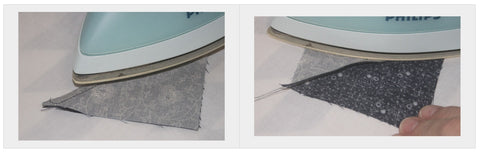
Line up the 45° diagonal angle on your ruler with the seam, then carefully trim with a rotary cutter.


Nine Patch Strip-Piecing Technique
The secret to a perfect nine patch is pressing seams so they butt together neatly when joined.


How to Resize Quilt Blocks
The first step in modifying any quilt block is to decide on your finished block size. You can base this on doubling a pattern, cutting it in half, or working with your available fabric.
Note: When working from a pattern's cutting instructions, remove the seam allowance before scaling. For example, if your pattern calls for 3½″ squares, subtract the seam allowance (½″), double the finished size (3″ → 6″), then add the seam allowance back (½″) — giving you a 6½″ cut piece.
Resizing Square Blocks
Add ½″ to your finished block measurement. For a 4″ finished square, cut a 4½″ square of fabric.
Resizing Rectangular Blocks
Add ½″ to both the length and width. To double a 3″ × 4″ block, cut a 6½″ × 8½″ rectangle.
Resizing Half-Square Triangle Blocks
Add 7/8″ to the desired finished block size. For a 4″ finished HST block, cut 4⅞″ squares.
Resizing Quarter Square Triangle Blocks
Add 1¼″ to the desired finished block size. For a 4″ finished block, cut 5¼″ squares.
0 comments