


New to quilting? Check out our beginner quilting class covering all the basics.
How to Sew a Kansas Troubles Quilt Block
The Kansas Troubles quilt block is a classic pattern perfect for beginner quilters who want to create a simple yet stunning design. It uses half-square triangles arranged in a checkerboard pattern to create a bold, graphic effect.
Materials Needed
- Fabric (at least two different colors)
- Rotary cutter
- Ruler
- Cutting mat
- Sewing machine
- Thread
- Iron
Step 1: Choose Your Fabric
Choose at least two different colors of fabric. Traditionally, this pattern uses dark, rich colors — for example, a dark blue fabric paired with a cream-colored fabric works beautifully.
Step 2: Cut Your Fabric
Cut your fabric into squares. For this tutorial, cut 4" squares from each fabric. You will need a total of 16 squares (8 from each fabric).
Step 3: Create Half-Square Triangles (HSTs)
Place two squares right sides together. Draw a diagonal line from corner to corner on the wrong side of one square. Sew a ¼" seam on either side of the line, then cut along the line to create two HSTs. Repeat with all 16 squares to produce 32 HSTs total.
Step 4: Press the HSTs
Press each HST to set the seam, pressing to one side. Repeat with all 32 HSTs.
Step 5: Arrange the HSTs
Place two HSTs right sides together with the dark side facing up and the light side facing down. Sew together to create a square. Repeat until you have 16 squares total.
Step 6: Sew Squares Together
Sew the squares together in rows to create the checkerboard pattern, using a ¼" seam allowance throughout. Press seams in alternating directions between rows so they nest together neatly.
Step 7: Press the Quilt Block
After sewing all squares together, press the completed block with the seam side up, pressing to one side.
Step 8: Trim the Quilt Block
Trim the edges of your block to make it even on all sides, using a ruler and rotary cutter to maintain the correct square size.
Congratulations! Repeat these steps to create as many Kansas Troubles blocks as you need for your quilt.
Half-Square Triangle (HST) Technique
This technique eliminates the need to directly manipulate the stretchy bias of the triangle. It uses two easy-to-cut squares and produces two HSTs at once.
Step 1: Draw the Diagonal Line
On the back of the lighter fabric, draw a pencil line diagonally from corner to corner.

Step 2: Sew Both Sides of the Line
Stack a pair of light and dark squares right sides together. Sew a ¼" seam allowance on each side of the line.

You will end up with something like this:

Step 3: Cut Along the Diagonal Line

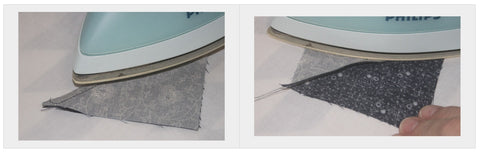
Step 4: Press the Seam
Press the seam together to set it, then press toward the darkest fabric.
Step 5: Trim to Size
Line up the 45° diagonal angle on your ruler with the seam, then carefully trim with a rotary cutter.


How to Resize Quilt Blocks
The first step in modifying any quilt block is to decide on your finished block size. You can base this on doubling a pattern, cutting it in half, or working with your available fabric.
Note: When working from a pattern's cutting instructions, remove the seam allowance before scaling. For example, if your pattern calls for 3½″ squares, subtract the seam allowance (½″), double the finished size (3″ → 6″), then add the seam allowance back (½″) — giving you a 6½″ cut piece.
Resizing Square Blocks
Add ½″ to your finished block measurement. For a 4″ finished square, cut a 4½″ square of fabric.
Resizing Rectangular Blocks
Add ½″ to both the length and width. To double a 3″ × 4″ block, cut a 6½″ × 8½″ rectangle.
Resizing Half-Square Triangle Blocks
Add 7/8″ to the desired finished block size. For a 4″ finished HST block, cut 4⅞″ squares.
Resizing Quarter Square Triangle Blocks
Add 1¼″ to the desired finished block size. For a 4″ finished block, cut 5¼″ squares.

0 comments